
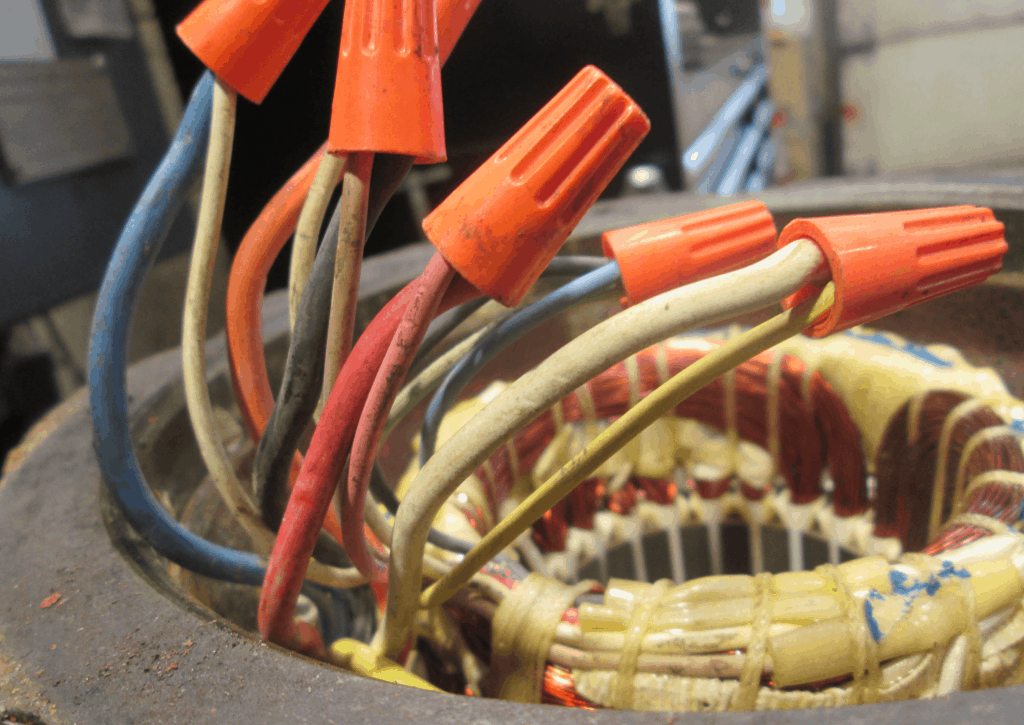
Proper Way of Connecting Wye-Delta Dual Voltage 6 lead Motor
A dual voltage Wye-Delta motor connection is most of the time mistaken as the same as a Wye start Delta run 6 lead motor. They are not. And although they have the same lead or terminal numberings, their application is totally different.
Most of the time, you can find this connection on IEC standard motors. Some NEMA standard motors like 2,300V/4160V motors have this connection too.
I’ll teach you how to connect a dual voltage Star Delta motor
1. Make sure that the circuit breaker or any type of disconnecting switch used is ‘OFF’.
2. Read the nameplate and confirm that the motor is dual voltage.
3. Measure the incoming voltage of the circuit breaker or disconnect with a multi-meter. Do it with caution.
4. If the incoming voltage matches or is close to the lower voltage indicated on the nameplate, connect the motor terminals to Delta.
5. If the incoming or supply voltage matches or is close to the higher voltage indicated on the nameplate, connect the motor terminals to Wye.
I’ll explain why each of the steps is important for safety reasons and at the same time avoid damage to your motor.
Step 1: Make Sure there is No Power going Into the Motor
- Turn Off the power. These could be a disconnect switch, circuit breaker, ON and OFF switch or a fuse box.
- Check the supply cable on the motor with a multi-meter and confirm if there is power.
- Always be on the safe side. Never ask anybody to turn it OFF for you. Do it yourself.
- Put a tag or a lock so no one accidentally turns it ON.
Step 2: Read the Nameplate Information
In the nameplate, it should indicate that there is only one Horsepower rating, one speed, one frequency rating but the voltage rating are two.
Examples of these are 230/400, 280/480, 480/830, 208-230/380, and some other IEC voltage configurations. 230 V is the low voltage and 380 is the high voltage.
Step 3: Check the Supply Voltage With Your Multi-meter.
This step is just for confirmation but if you’re absolutely right about the supply voltage, you might skip it. Motor Rewinding Solutions.com is concerned for your safety.
The supply side is the input voltage going into the circuit breaker, the three cables just before the fuses, or if you have a magnetic contactor, the input at the top of the unit.
Step 4: If the Supply Voltage Matches the Low Nameplate Voltage, Connect your Motor to Delta.
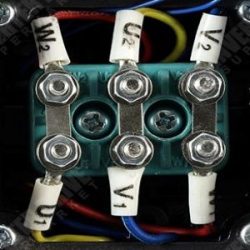
.
The reason for this is that the Line Voltage on a Delta connection is the same as the Phase Voltage ( V line = V Ø on Delta). The group of coils on every phase inside the motor are designed to handle the full Low Voltage supply
Step 5: If the Supply Voltage Matches the High Nameplate Voltage, Connect your Motor to Wye.
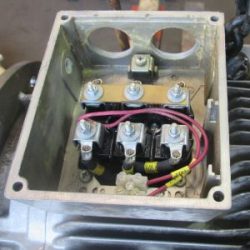
The reason for this is that the Line Voltage in a Wye connection is equal to the Phase Voltage X 1.732 (V line = V Ø on Wye). This means that at the Wye connection, the motor coils that are designed for Delta are able to stand a higher voltage of 1.732 times the Rated Voltage.
For example, a motor designed for 230 Volts Delta can be supplied with 380 volts when connected to Wye. With that said, don’t just pick a connection to wire a motor hoping that it will work. By chance maybe it will but you are also risking damage to the motor.
Can you connect a dual voltage 6 lead motor to a Wye-Delta starter?
If your motor is 7.5 HP or larger, there might be a need of using a Wye-Delta starter. The question is can you use this on a 6 lead dual voltage motor?
You can use a Wye-Delta starter on a 6 lead dual voltage motor as long as you use the low voltage rating on the motor nameplate. This also means that the low voltage rating of the motor matches the supply voltage.
For example, on a 230/380-volt motor, you can use the Wye-Delta starter on the 230 volt Delta connection. You will use Wye as the Starting connection and Delta as the Run connection.
What if the supply voltage is 380 volt? If the input voltage to the motor matches the high voltage rating of the motor, you have to connect it to Wye and you cannot use the Wye-Delta starter.
Alternative Starters If a Dual Voltage 6 Lead Motor is Connected Wye.
When the supply voltage requires you to connect the motor to Wye, you cannot use the Wye-Delta starter. But there are other alternatives. Some of the choices are:
- Across the Line or Direct on Line
- Reduced Voltage Starting
- Electronic Soft Starting
- Rewinding the Motor to Single Voltage 6 Lead Wye-Delta
Except for connecting your motor directly from the power source, all the other methods of motor starting may be more expensive but there are times when you just don’t have a choice.
If your motor failed because of frequent stops and starting and needs to be rewound, you can consider telling the repair shop to rewind the motor into 6 leads Wye-Delta using the high voltage rating.
For example, if your supply voltage is 460 volt and you have a 380/460 V motor for rewind, you can have it rewound for 460V 6leads Wye-Delta. It will be just a single voltage motor and this will work on a Wye-Delta Starter. Motor Rewinding Solutions is willing to give you the redesigned parameters but I need the original data of the motor windings.
How to Tell for Sure that the Motor is Dual Voltage?
You might say it is easy. Just look at the nameplate and if there are two voltages the motor is dual voltage.
A motor is considered dual voltage if the low nameplate voltage is 58% of the high voltage rating. If the nameplate has two voltages but the difference is only 10%, it is the range of allowable voltage that the motor can handle but not considered a dual voltage motor.
An example of this is a motor with a 530/580V nameplate voltage. This is considered a single voltage motor and should not be mistaken as a dual.
Why do the manufacturers do that? They designed the motor to handle a range of voltage so they can market it to countries with different supply voltages and still deliver the torque the motor nameplate says it will. A smart thing to do.
Is It better if the Dual Voltage Motor is Connected Wye or Delta?
Some confusion arises as to which connection is better when it comes to torque strength or efficiency. Although that may be true in the manufacturing side of the motor, for us end-users of the motor, there is no effect on the horsepower or otherwise efficiency if you connect it Delta or Wye. Here is the fact;
On a Dual Voltage Motor, as long as it is connected Delta on low voltage applications or Wye on the high voltage applications and the supply voltage corresponds to these voltages, the horsepower or the KW rating of the motor will be the same on both connections
The only advantage you can have is the privilege to use it on a Wye-Delta starter but this is limited to the use of the low voltage rating only.
Every motor is designed by the manufacturer to run on a specific type of connection and we cannot change that unless we redesign and rewind the motor.
On the Wye connection, the voltage per turn is smaller compared to Delta which means there is less strain on the wire insulation.
However, because the motor manufacturer wants to provide the customers with motors that have the ability to use Wye-Delta Starters, they produce Delta-connected motors. But that’s only one of the many reasons.
Connect a 6 lead Dual Voltage Motor into Wye or Delta Using this Table
Depending on what type of leads you have on the terminal box, you are supposed to connect a 6 lead dual voltage motor a certain way. This is the table on how the leads are supposed to be connected.
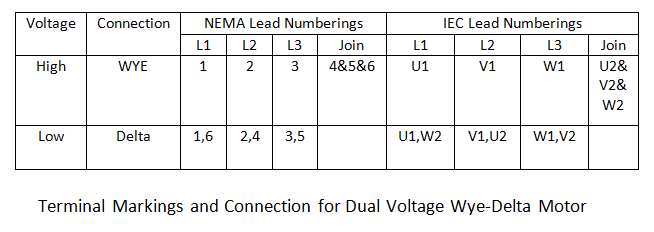
If the motor uses a terminal block on its connection box, be sure that the right lead numbers are joined by the brass links. Some leads are color-coded but you will still notice that T1, T2, T3, T4, T5, and T6 are printed on the leads.
Proper Way of Connecting Wye-Delta Dual Voltage 6 lead Motor Read More »